


China Furniture Exhibition | Boss Office Renovation: Choose the Right Furniture to Double Your Deal Closing Efficiency
As the top barometer of the global home and office furniture industry, China Furniture Exhibition clearly presents the latest changes in commercial space design every year. In recent years, the high-end office furniture exhibition area has been gaining increasing popularity. More and more business owners have realized that the boss's office is no longer just a "face project", but an invisible deal-closing system that can subtly influence customers' decisions. Its value never lies in how expensive the furniture is, but in whether the entire space knows how to "communicate silently"—whether it can quickly dissolve customers' defensive psychology and build deep trust through furniture layout, materials and details, ultimately making cooperation negotiations flow naturally.

I. Furniture Layout: Narrowing Psychological Distance with Spatial Language
Business psychology research shows that the physical distance between people directly affects their psychological distance and level of trust. The furniture layout of a boss's office is essentially designing a "psychological dialogue", and every inch of space arrangement conveys your attitude to the client.
Executive Desk: Bigger Isn't Always Better—The Right Size Builds Better Rapport
Many bosses mistakenly believe that a larger executive desk signifies greater strength, but they fail to realize that an overly wide desk creates an insurmountable "physical barrier" between you and the client. When a client has to speak to you from a distance of more than 1.5 meters, they will instinctively feel like they are being "interrogated", and their psychological defenses will instantly rise.
The mainstream executive desk designs at China Furniture Exhibition have long abandoned the misconception of "big and empty", with a depth of 1.0-1.2 meters becoming the industry consensus. This size can comfortably accommodate computers, documents and tea sets, while maintaining a comfortable social distance between you and the client—neither too intimate to seem unprofessional nor too distant to create estrangement. At the same time, the placement of the executive desk is also important: it is best to back against a solid wall and face the door, so that the client can see you at first glance when entering, which not only shows respect for the client but also allows you to take the initiative in the entire space.
Meeting Area: Eye Level is the Beginning of Trust
The common layout in traditional offices where the boss sits on a high executive chair while the client sits on a low sofa is actually a major taboo in business negotiations. When a client has to look up at you, they will feel a strong sense of inequality and subconsciously think that you are arrogant and difficult to communicate with.
A truly efficient meeting area should follow the "eye level principle": the height difference between sofas and chairs should be controlled within 5 cm, and it is best to choose furniture of the same style or height. In terms of seating arrangement, avoid placing the client in the "passive position" directly facing the door, and do not trap them in a corner with an L-shaped sofa. A 90-degree angle seating or side-by-side seating is the best choice—it allows for eye contact without creating a face-to-face confrontational feeling. If space permits, setting up a separate meeting area isolated from the office area is even better, as it ensures the privacy of the conversation and allows clients to express their needs more relax.
II. Material Selection: The "Tactile Business Card" of Your Enterprise, Silently Conveying Strength
Clients will not directly ask how much revenue your company generates or how large your team is, but they will subconsciously judge your enterprise through what they see and touch. The material of furniture is the most intuitive "tactile business card" of an enterprise, and every texture and touch tells the story of your enterprise's style and strength.
Solid Wood: Conveying the Message of "Stable, Reliable, and Worth Long-Term Cooperation"
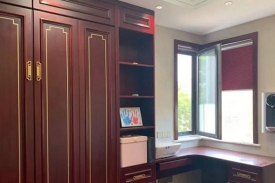
At China Furniture Exhibition, solid wood office furniture has always been the first choice for high-end commercial spaces. The deep warmth of walnut, the simple elegance of oak, and the warm delicacy of cherry wood—natural wood textures come with a sense of time沉淀, conveying the signal that "the enterprise has a solid foundation and does things reliably".
Leather: Comfort Reflects Attention to Customer Experience
The choice of leather for sofas and chairs in the meeting area is crucial. Inferior artificial leather has a rough feel. It sticks to the skin when sitting for a long time in summer and is icy cold in winter. If clients are uncomfortable sitting, they will naturally want to leave early.
III. Efficiency Lies in the Details: Invisible Professionalism is the Most Impressive
Many bosses only focus on the appearance of furniture when decorating their offices, but ignore those details that affect negotiation efficiency. In fact, true professionalism is reflected in these invisible places.
Lighting: 4000K Neutral White Light, Ideal for Business Negotiations
The color temperature of lighting directly affects people's emotions and attention. Warm yellow light below 3000K is too cozy and easy to make people drowsy, which is not suitable for serious business negotiations; cold white light above 5000K is too harsh and can make people feel nervous and anxious.
4000K neutral white light is the best choice. It is close to the color of natural light, neither cold nor drowsy, allowing people to maintain a clear mind, which is most suitable for reading contracts, reviewing proposals and discussing details. In terms of lighting layout, do not use a single main light, but adopt a combination of "main light + spotlights + light strips" to avoid glare and shadows. A soft chandelier can be installed above the meeting area to focus on the conversation area and create a focused atmosphere.
Storage and Coffee Table: Convenience for Clients is Convenience for Yourself
The height of the coffee table in the meeting area should preferably be controlled between 40-45 cm, which is the optimal height according to ergonomics. It is convenient for clients to place documents and pick up water cups, and will not become an obstacle to communication. The coffee table should not be too large, nor should it be decorated with too many ornaments, leaving enough space for contracts and documents.
IV. Ultimate Goal: Creating a Trustworthy Space That Puts Clients at Ease
The competition in office furniture has long shifted from "appearance comparison" to "value empowerment". A carefully selected set of office furniture is not only a reflection of the boss's personal taste, but also an extension of the enterprise's brand image. Remember, when a client sits in your office, they are not just "looking at the decoration"—they are "experiencing your enterprise". Every piece of carefully chosen furniture together builds a space where clients are willing to let down their guard and establish trust, which is the most advanced "deal-closing assist".
Source: Official Accounts: New Chinese Style Office Furniture