CIFF Shanghai | Home Decoration Goes Green: Starting with De-woodification
CIFF Shanghai is focusing on the new trend of healthy home decoration. Today, virtually every home decoration brand markets itself as eco-friendly, yet most homeowners still leave their newly renovated properties empty for six months of ventilation before moving in. Relying solely on ventilation does little to completely eliminate hidden pollution risks.
Many homeowners mistakenly believe that decoration pollution is limited to formaldehyde and that prolonged airing can fully remove it. In reality, harmful pollutants from renovation are numerous, with many sources buried deep inside materials and release cycles far longer than commonly assumed. This is precisely why residents still experience discomfort after moving in despite extensive ventilation.
Formaldehyde is a chronic pollutant with a release cycle of 3 to 15 years, emanating from engineered wood panels, adhesives, paint, and synthetic carpets. Its concentration spikes significantly during summer months and when underfloor heating is in use, and it is classified as a Group 1 carcinogen. Benzene compounds are highly toxic pollutants most prevalent in the early renovation phase, commonly found in coatings and adhesives, with peak volatilization occurring within the first six months after completion, causing direct and rapid harm to human health. TVOC (Total Volatile Organic Compounds) is the primary source of pungent renovation odors, comprising hundreds of chemical components that readily trigger dizziness and eye irritation.
Common formaldehyde removal solutions available on the market deliver very limited results. Plants like pothos offer negligible pollutant absorption. Activated carbon can only capture free-floating harmful substances in the air and will re-release pollutants once saturated. Professional formaldehyde treatment services address only surface-level contamination and cannot tackle the continuous release of harmful substances from within panel cores. Ventilation, adsorption, and chemical decomposition are all reactive, after-the-fact remedies. To fundamentally reduce pollution, environmental safeguards must be shifted upstream to the material selection phase.
Even when using wood panels certified to the highest ENF environmental grade, the cumulative pollution effect across an entire home cannot be avoided. A single furniture piece may incorporate more than a dozen panels, while whole-house customization can accumulate over a hundred. As various panels continuously emit trace amounts of harmful substances, their cumulative effect can easily push indoor air quality beyond safe limits. Moreover, wood panels carry inherent vulnerabilities: they are susceptible to moisture and temperature fluctuations, making them prone to warping, cracking, and mold. Wood wax oils and paints applied to solid wood surfaces also continue to release TVOC over time.
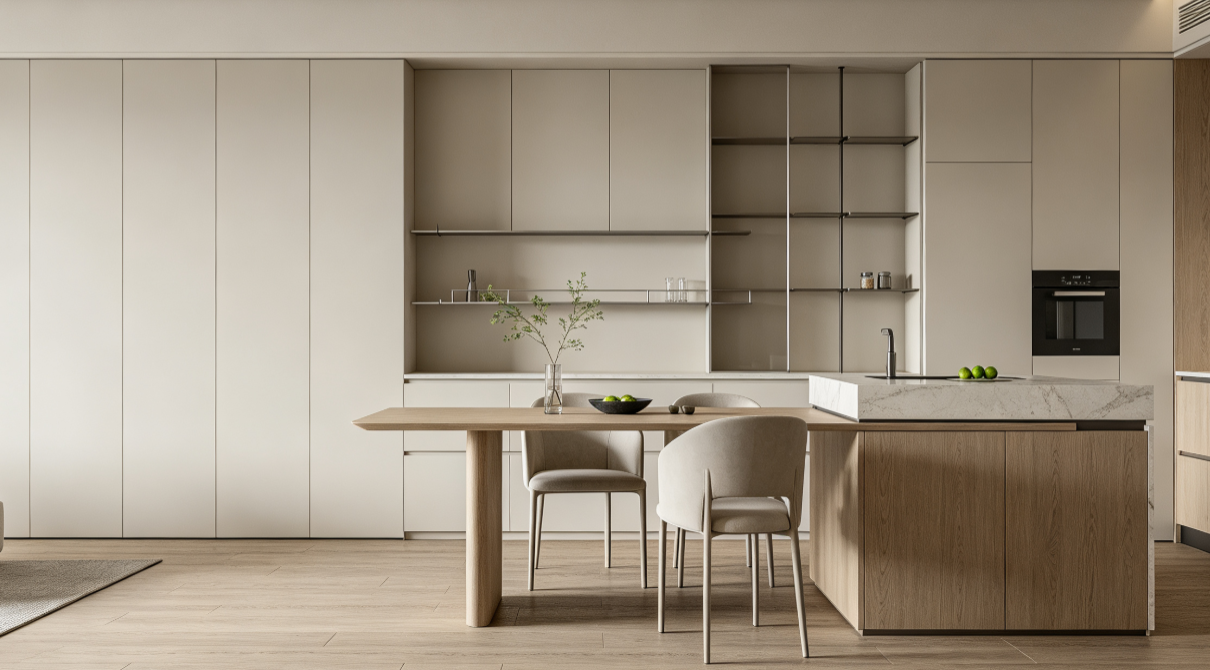
To circumvent this dual challenge, an innovative home decoration approach has gained traction within the industry: the de-woodification concept. De-woodification does not entail completely eliminating the visual warmth of wood; rather, it calls for drastically reducing the volume of wood panels used throughout the home and replacing them with environmentally friendly, stable, and durable polymer composite materials. Combined with prefabricated dry-construction techniques that minimize on-site use of adhesives and coatings, this approach controls the three core pollutants—formaldehyde, benzene compounds, and TVOC—at the source.
Walls are clad in aviation-grade composite prefabricated panels that replace latex paint, wallpaper, and wall coverings. These panels are waterproof, mold-resistant, flame-retardant, and abrasion-resistant, with a service life exceeding 15 years and requiring minimal routine maintenance. Flooring pairs with premium SPC (Stone Plastic Composite) planks installed via dry construction, which preserves ceiling height, performs well with underfloor heating, and offers waterproof, corrosion-resistant, and wear-resistant properties. The wood-grain finish delivers aesthetic appeal alongside environmental benefits, with lower long-term upkeep costs.
Ceilings are differentiated by space: bedrooms and living rooms feature low-moisture, putty-free gypsum boards installed through prefabricated methods that eliminate leveling work. These boast a service life of over 30 years and meet the F4-star environmental standard. Kitchens and bathrooms employ honeycomb large-format integrated ceiling panels that resist water and oil stains while allowing easy access for maintenance. Whole-house storage systems utilize aviation-grade composites paired with metal wall-mounted frameworks; modular components can be reconfigured as needed, resist moisture and mold, and meet ENF environmental standards.
Genuinely eco-friendly home decoration cannot rest on marketing slogans alone. Post-completion air quality testing is a non-negotiable requirement. Before final handover, brands commission on-site spot inspections by third-party agencies holding authoritative CNAS accreditation. Only when formaldehyde, benzene, and TVOC readings all fall within compliance limits is the project officially delivered.
Rather than enduring months of passive ventilation to purge pollutants after renovation, homeowners can opt for a de-woodified whole-house solution at the planning stage—eliminating concerns over indoor harmful gases and providing comprehensive protection for family health. An increasing number of home decoration firms are deepening their commitment to low-emission prefabricated materials. Through the exhibition and exchange platform provided by CIFF Shanghai, they continue to advance the new philosophy of healthy home decoration that controls pollution at its source.
Source: shushidujiazhuang